
Introduction
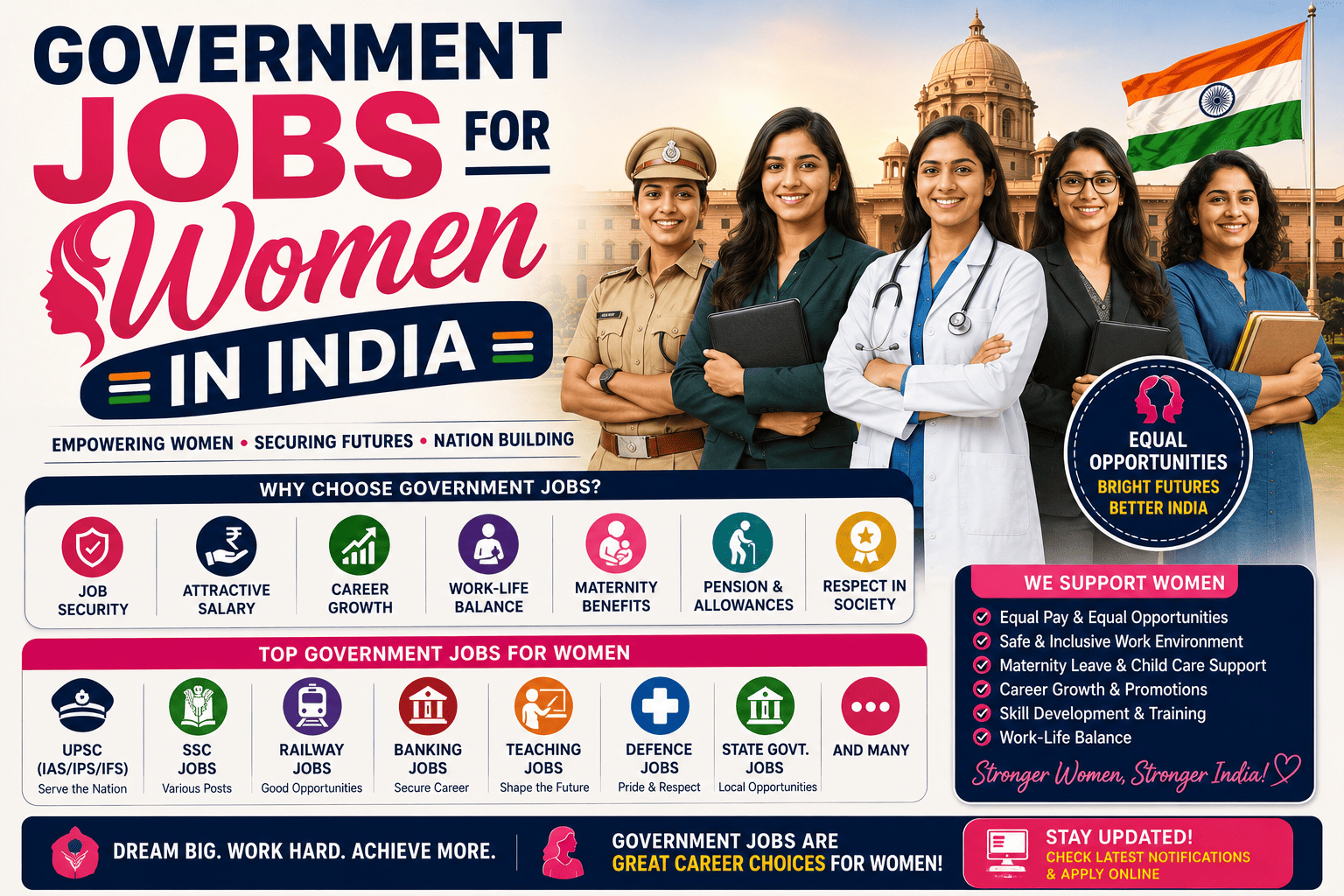
Government jobs in India offer women a safe, structured, and respected professional environment with legal protections, maternity benefits, and promotions based on merit. With growing emphasis on gender inclusion in public sector hiring, more women are competing for — and securing — government positions at every level, from constables to IAS officers.
Also See
Why Government Jobs Are Ideal for Women
- Maternity leave: 26 weeks of paid maternity leave for the first two children — far beyond most private sector employers
- Child Care Leave (CCL): Up to 2 years over the entire career to care for children under 18
- Job security: Employment protected by service rules — no arbitrary dismissal
- Fixed working hours: Standard 9–5 with weekends off in most government offices
- Fee waivers: Women are fully exempted from application fees in most central government exams
- Safe workplace: Mandatory POSH committees and strong harassment redressal mechanisms
Top Government Jobs for Women in India
1. Teaching (KVS, NVS, State Teachers)
Most popular government career among women. KVS and NVS recruit PGT, TGT, and PRT teachers with excellent pay, long vacation periods, and CCL benefits.
2. Banking (IBPS PO/Clerk, SBI, RBI)
One of the most women-friendly government sectors. Banking workplaces are well-regulated, and female employees make up a significant proportion of public sector bank staff.
3. SSC (CGL, CHSL, MTS, Stenographer)
Opens central government clerical and officer-grade positions for women. SSC Stenographer Grade C and D is especially popular. Women are fully exempted from application fees across all SSC examinations.
4. Police and Paramilitary (Women Constable, SI)
State police forces and CRPF, BSF, CISF recruit women constables and Sub-Inspectors. Separate, lower physical standards are defined for women candidates.
5. UPSC Civil Services (IAS, IFS, IPS)
Women have consistently topped UPSC rankings in recent years. IAS and IPS careers offer immense social influence, policy-making authority, and national prominence.
6. Healthcare (AIIMS, ESIC, State Health Services)
Doctors, nurses, ANMs, and health assistants are recruited across government hospitals and AIIMS regularly — strong and growing demand for women in public healthcare roles.
Salary and Benefits
| Job | Approx. Salary | Key Benefits |
|---|---|---|
| KVS/NVS TGT Teacher | ₹44,900–₹60,000/month | Summer/winter vacations, CCL |
| IBPS PO / SBI PO | ₹42,000–₹58,000/month | Concessional loans, NPS pension |
| IAS/IPS (Entry Level) | ₹56,100+ allowances | Housing, vehicle, CGHS |
| SSC CGL Officer | ₹35,000–₹65,000/month | HRA, TA, annual increment |
| Women Police Constable | ₹21,700–₹35,000/month | Uniform allowance, medical benefits |
| ANM/Staff Nurse (Govt.) | ₹25,000–₹45,000/month | CGHS, housing, uniform allowance |
Age Limit and Relaxations
Most government jobs have age limits between 18 and 30–35 years. Women in many states receive additional relaxation of 3–5 years. Widows, divorced women, and women judicially separated from their husbands often receive further relaxation up to 35–45 years for certain posts.
How to Apply
- Identify the right exam based on your qualification and career interest
- Visit the official recruiting body website
- Confirm fee exemption status (most central exams exempt women candidates)
- Register online and fill the application form accurately
- Upload required documents in the specified format and size
- Submit before the deadline and save the confirmation
Tips for Women Aspirants
- Use fee exemption wisely — apply for multiple eligible exams with zero financial barrier
- For teaching, CTET qualification opens doors across KVS, NVS, and Army Schools simultaneously
- Check state-level women’s reservation quotas — many states have 33% or more horizontal reservation for women
- Physical fitness preparation for police and paramilitary posts must begin 3–4 months before the exam
- Join online study groups and women-focused preparation programs with flexible timing options
Common Mistakes to Avoid
- Not checking state-level women’s quotas that may significantly improve selection chances
- Overlooking widowhood or separation relaxation benefits when eligible
- Limiting applications only to “safe” or stereotypically feminine jobs — police, defence, and engineering roles are equally open
- Ignoring the maternity and CCL entitlements when evaluating job offers after selection
Frequently Asked Questions
1. Which is the best government job for women in India?
Teaching (KVS/NVS/State), banking (IBPS/SBI PO), and civil services (IAS/IPS) are consistently the most popular and well-suited government career options for women in India.
2. Is there a reservation for women in central government jobs?
There is no horizontal reservation for women at the central level, but women benefit from age relaxation, fee waivers, and maternity/CCL protections. Several states provide 33% horizontal reservation for women in state government jobs.
3. How much maternity leave does a central government employee receive?
26 weeks (approximately 6 months) of paid maternity leave for the first two children, plus up to 2 years of Child Care Leave (CCL) over the entire career.
4. Can women join the Indian Police Service (IPS)?
Yes. Women have served in the IPS since 1972, appearing for the UPSC Civil Services Exam and serving in all operational and administrative roles.
5. What is the application fee for women in SSC exams?
Women are fully exempted from application fees across all SSC examinations including CGL, CHSL, MTS, GD, CPO, JE, and Stenographer.
6. Are government nursing jobs widely available in India?
Yes — nursing recruitment is conducted by AIIMS, ESIC, Railways, Indian Army, and state health departments on a regular basis throughout the year.
7. Are there teaching jobs available without a B.Ed. degree?
Primary teacher (PRT) posts in some states and certain assistant teacher categories do not require B.Ed., but do require TET or CTET qualification.
8. Can I continue working in a government job after marriage?
Absolutely. Government employment in India is permanent regardless of marital status — marriage has no bearing whatsoever on service continuity for women employees.
Conclusion
Government jobs in India offer women a secure, respectful, and professionally fulfilling career path. From the flexibility of teaching schedules to the authority and prestige of a civil services posting, each option carries distinct strengths. The expanding scope of women in police, defence, banking, administration, and healthcare reflects a genuinely positive shift in India’s workforce landscape. Choose your target post, use every benefit and relaxation available to you, and prepare with dedication.