
Introduction
The Union Public Service Commission (UPSC) conducts some of India’s most prestigious and challenging recruitment examinations. UPSC jobs represent the pinnacle of government service — from the Indian Administrative Service (IAS) and Indian Police Service (IPS) to defence officer entries through CDS and NDA. These careers combine power, purpose, and public impact in a way few other careers can match.
Also See


Major UPSC Examinations
- Civil Services Exam (CSE) — For IAS, IPS, IFS, IRS, and 22+ central services
- CDS (Combined Defence Services) — Officer entry into Army, Navy, Air Force
- NDA (National Defence Academy) — 12th pass entry into defence academies
- ESE/IES (Engineering Services Exam) — For engineers joining central technical services
- CAPF (AC) — Assistant Commandant in BSF, CRPF, ITBP, CISF, SSB
- UPSC EPFO — Enforcement Officer/Accounts Officer in EPFO
Eligibility: Civil Services Exam (UPSC CSE)
Education: Graduation from any recognised university. Age: 21–32 years (General); OBC 21–35; SC/ST 21–37. Attempts: 6 (General), 9 (OBC), unlimited within age limit (SC/ST). Indian citizenship is mandatory.
UPSC CSE: Three-Stage Selection Process
Stage 1: Preliminary Exam (Prelims)
Two papers — GS Paper I (General Studies, 200 marks) and GS Paper II CSAT (qualifying, 33% minimum required). Prelims marks do not count in the final merit — it is purely a screening exam to limit Mains candidates.
Stage 2: Main Exam (Mains)
Nine papers totalling 1,750 counted marks plus 2 qualifying language papers. Covers Essay, General Studies I–IV, and Optional Subject (2 papers of 250 marks each). The quality of answer writing determines your final rank more than any other single factor.
Stage 3: Personality Test (Interview)
275-mark interview conducted by the UPSC board. Evaluates intellectual curiosity, critical thinking, leadership potential, and communication. Final Merit = Mains Score + Interview Score.
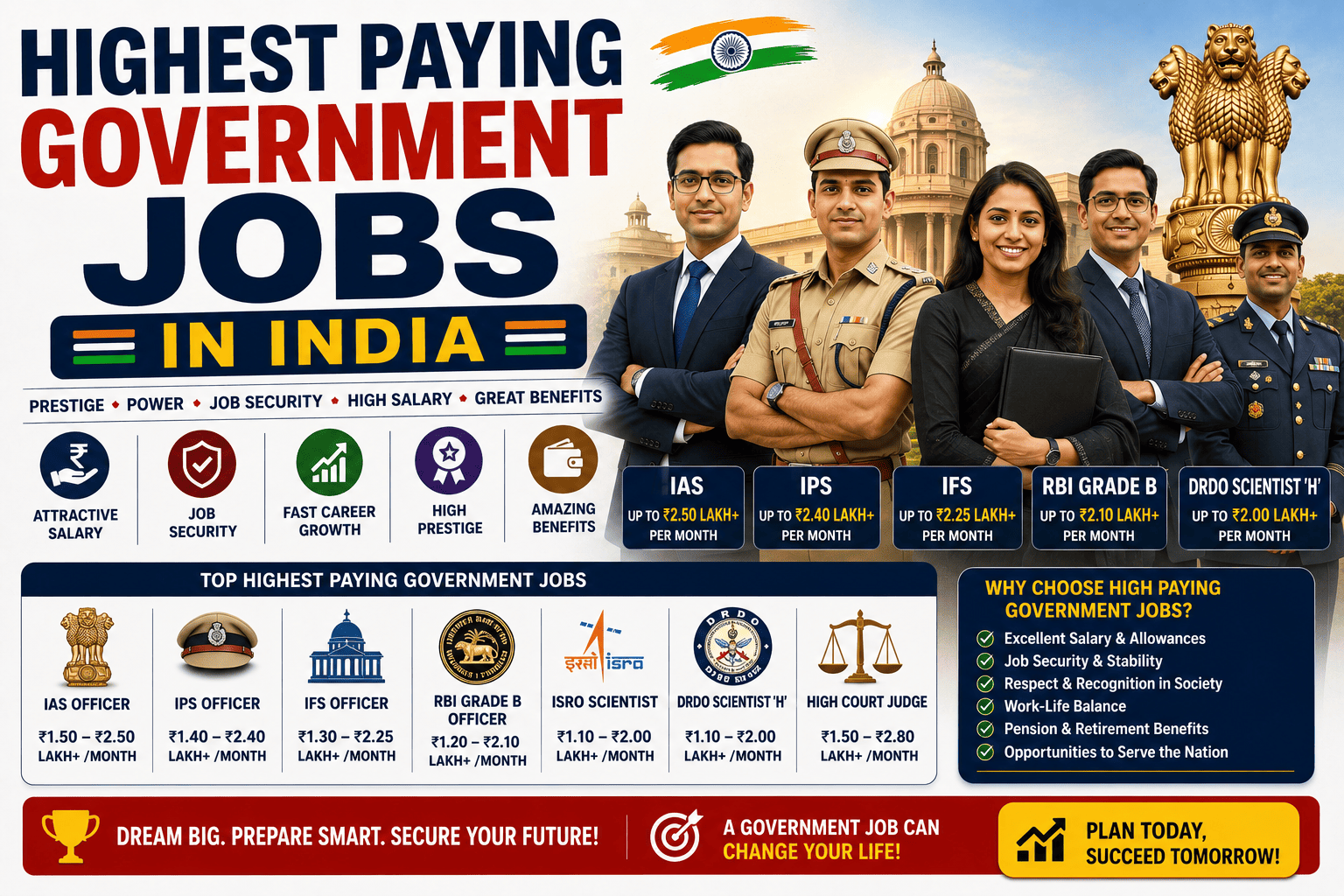
UPSC Jobs: Salary and Pay
| Service | Pay Level | Approx. Starting Salary |
|---|---|---|
| IAS / IPS / IFS | Level 10 | ₹56,100/month + allowances |
| IRS / IRAS / IA&AS | Level 10 | ₹56,100/month + allowances |
| Army Lieutenant (CDS) | Level 10 | ₹56,100 + MSP ₹15,500/month |
| CAPF Assistant Commandant | Level 10 | ₹56,100/month + allowances |
| UPSC EPFO EO/AO | Level 8 | ₹47,600/month + allowances |
Benefits Beyond Salary
- Government accommodation and official vehicle for senior officers
- CGHS (Central Government Health Scheme) for self and family
- Children’s educational allowance and hostel subsidy
- Leave Travel Concession (LTC)
- Pension under NPS and generous retirement benefits
- Post-retirement appointments as Governors, Ambassadors, PSU Board heads
How to Apply for UPSC Exams
- Visit upsc.gov.in — the official UPSC portal
- Check the annual exam calendar (published each October)
- Register on the OTR (One Time Registration) portal
- Fill the Detailed Application Form (DAF) when the exam notification is released
- Upload a recent passport-size photo and signature
- Pay exam fee (₹100 for CSE; waived for SC/ST/PwD/Women)
- Submit and download the filled application for reference
UPSC Preparation Tips
- Start with NCERT: Class 6–12 across History, Geography, Polity, Economics, and Science builds the conceptual foundation
- Choose optional wisely: Contributes 500 marks — select based on academic background and genuine interest, not popularity
- Answer writing is the key skill: Practice structured, analytical answers from Month 2 of preparation onwards
- Current affairs daily: Read The Hindu or Indian Express — make concise, organised notes
- Revise more than you study new: Regular revision beats covering new material without revisiting what you’ve learned
- Take Prelims seriously: Many capable candidates underestimate Prelims — treat it as a standalone competitive exam
Common Mistakes to Avoid
- Starting without a structured long-term plan — UPSC rewards systematic preparation over random effort
- Failing CSAT — though qualifying, missing 33% disqualifies you regardless of GS performance
- Choosing an optional based on peer opinion rather than personal strength
- Not practising previous year question papers (PYQs) — UPSC revisits themes across years
- Neglecting physical and mental health during the long preparation period
Frequently Asked Questions
1. How many IAS seats are available each year?
UPSC announces 900–1,200 total vacancies across all services annually. Around 80–180 are specifically for the IAS cadre, depending on the year’s requirement.
2. What rank do I need to get IAS?
Typically within the top 90–100 in the final UPSC merit list. The exact cut-off varies each year based on vacancies and category distribution.
3. Can a working professional prepare for UPSC?
Yes — many successful candidates cleared UPSC while employed, dedicating 4–6 hours daily outside work hours over 2–3 years.
4. Is UPSC only for IAS?
No. UPSC conducts 14+ examinations annually including CDS, NDA, CAPF, ESE, EPFO — each leading to prestigious careers beyond just IAS.
5. What is the best optional subject for UPSC CSE?
Popular choices include Public Administration, Geography, History, Sociology, Anthropology, and PSIR. The best choice depends entirely on your academic background and genuine interest.
6. How long should I prepare for UPSC?
Most successful full-time candidates prepare 12–24 months. Working professionals may need 2–3 years. Consistency and quality of preparation matter more than total hours.
7. Is the UPSC Personality Test eliminatory?
No — almost all Mains-cleared candidates are called for the interview. However, interview marks (out of 275) significantly affect your final rank and service allocation.
8. Can a 12th pass student apply for any UPSC exam?
Yes. NDA and NA exams are designed for Class 12 students (17–19 years) as the entry point into the defence services via UPSC.
Conclusion
UPSC jobs represent the most impactful and prestigious careers in India’s public sector. The journey is demanding — but the rewards, both personal and professional, are unmatched. If you can commit seriously for 12–24 months, a UPSC career is genuinely within reach. Visit upsc.gov.in, download the syllabus, and begin today. Every topper started exactly where you are now.